Wednesday, May 31, 2017

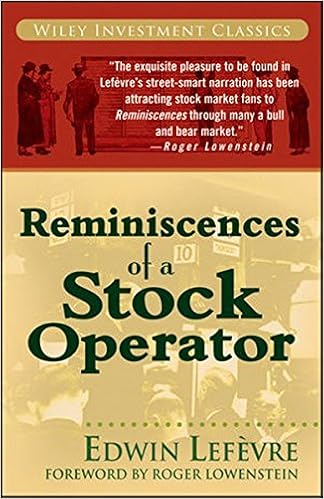
Lefèvre, Edwin (1923): Reminiscences of a Stock Operator

What is it about?

The book is a biography of a stock trader (or speculator), reportedly covering the life Jesse Lauriston Livermore.

The book is set in early 20th century (the book was originally published in 1923), and is organized chronologically and organized around highlight events (often particularly successful or unsuccessful or otherwise "teaching" trading campaigns).

Was it good?

The book is extremely good. Not only is it written in a very entertaining and personal style, but it also dispenses quite poignant observations of the human condition.

Indeed, one could say that the psychological observations of human nature and general psychological tendencies are the most valuable content in the book.

And even if one is not interested in any such observations, the book makes quite entertaining reading nonetheless.

The main take-away for me?

Besides the insights about inherent human psychology, a thought that I constantly kept on having throughout the book is "that wouldn't work today". And, in fact, the author (the narrator) admits in the very last pages of the book that his exploits had become increasingly difficult already in the 1920s: there was more stocks traded, more information to digest (impossibly much already in the 1920s), more stringent regulations on insider trading (a very central phenomenon in Livermore's exploits, though he himself was not an insider) and so on.

In any event, the book illustrates very nicely how the speculators got their name and stereotypical character in the early 1920s: already then the speculators were wholly uninterested in the "real" economy, only looking for how the "stocks acted" for the purpose of turning a profit on stock price developments.

Who should read the book?

If one is at all interested in financial economy and the stock market in particular, reading the book - despite its peculiar historical context - is time most assuredly time well spent.

The book on Amazon.com: Reminiscences of a Stock Operator

Graeber, David (2014): Debt - The First 5,000 Years

What is it about?

The book describes how people have perceived and interacted through debt until about early 1970s, from the start of recorded history.

The book most certainly has an agenda. This agenda is to suggest that the modern notion of debt, an impersonal numerically expressed money sum involving parties which have little to no personal connection, is an anomaly in the historical record.

Moreover, the author suggests that this calculating, impersonal and mathematical understanding has brought about all kinds of undesirable social effects such as greed, self-centeredness and so on. After all, according to the author, social relations are significantly more healthy if debt includes a social aspect even if debts are generally expected to be paid back in a way or another.

Was it good?

The basic setup, the main argumentative line, and the conclusions certainly are highly interesting, and the author's train of through and evidence-based reasoning is credible. One certainly can't miss the basic message or its support from the historical record.

However, delivering this message takes nearly 500 pages. That's a lot. Most of the pages are used for quite detailed historical descriptions from different eras, which to my taste started to be a bit too much to my taste.

Once again, this book too would be significantly more enjoyable, if the middle 400 pages were compressed into, say, 1/4 of their current length. If appropriately done, I can't see the basic message being diluted a bit.

The main take-away for me?

Well, I presume that the basic message of the book is the main take-away. Namely, how people perceive debt (like any institution or social convention) has significant societal effects. In the case of debt, when debt is being perceived as an impersonal mathematical construct, the morality concerning debt and economic behavior more generally is very different from a society where debt is between people who know each other and interact on a regular basis.

Who should read the book?

In its current form (length), it is not very easy to recommend the book - unless one reads just the first and last 50 pages or so, and cursorily scans everything between. In any case, the basic message is one which should be heard wide and far in the Western world, as it provides a nice contrast to how things are today - and shows that they could be otherwise too.

The book on Amazon.com: Debt

Thursday, May 4, 2017

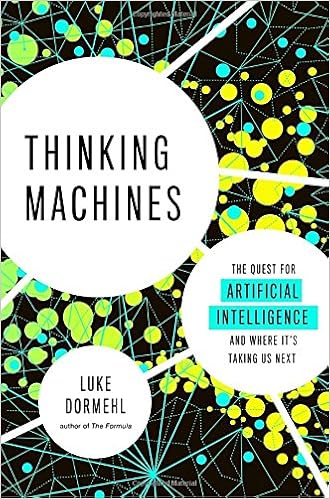
Dormehl, Luke (2017): Thinking Machines - The Quest for Artificial Intelligence--and Where It's Taking Us Next

What is it about?

The book is an excellent and quite accessible overview of artificial intelligence, or AI (what it is, what approaches there are to AI, what AI currently can and can not do), including a historical overview of the origins and early developments of AI.

In addition, and importantly, the book has a good deal of forward-looking discussion about how AI conceivably could develop in the (near) future, and what kinds of questions this could bring about, especially with respect to ethics and legislation (e.g. responsibility questions in driverless cars).

Was it good?

I thoroughly enjoyed the book. The informational contents are - at least for me - in a good balance in terms of basics and "frontiers", and especially the case illustrations (e.g. IBM's Jeopardy-winning AI the Deep Mind) nicely make the discussion concrete.

However, what I really appreciated was that the author successfully resisted the temptation to launch into science fiction-like speculations towards the end of the book (through the notion of conscious AI, the singularity etc. were covered). Instead, all the future-looking and ethics-related discussion is firmly rooted in what current and realistically foreseeable technology could enable.

The main take-away for me?

After reading the book, I probably understand and appreciate more the "mundane" applications of AI (e.g. movie recommending systems, autonomous driving software), and how anticipated developments in the near future may influence our lives and force us to rethink to a degree the premises in our legal systems (e.g. what about if a credit screening system is found to discriminate against a group of people, but because the system is implemented with a neural network, nobody can discern how those credit screening decisions are made?).

Who should read the book?

If one is at all interested in information technology and "big data" or the topic of artificial intelligence in particular, but is not entirely sure what the fuss is about, this book is well worth reading.

The book on Amazon.com: Thinking Machines

Tuesday, April 25, 2017

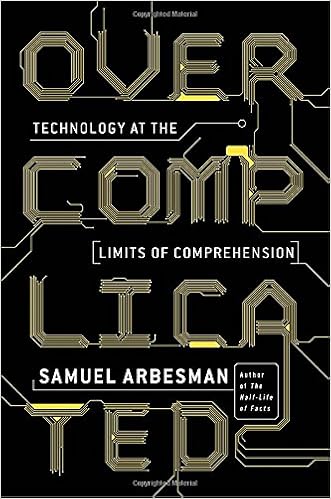
Arbesman, Samuel (2016): Overcomplicated - Technology at the Limits of Comprehension

What is it about?

The basic position of the book is that the technological environment in which we live has become so complex that in many cases we no longer fully understand let alone control how technology works. Especially this is true in large technical systems such as the Internet, or electricity or water distribution.

Thus, complex technological systems exhibit emergent behavior which is at times surprising to us because due to their complexity, their behavior can not be modelled or otherwise anticipated in all possible circumstances.

As examples, complex technological systems cause phenomena such as sudden swings in financial markets (computerized systems trading by themselves at a very high speed) and large-scale electricity outages (a single failure causing a cascade of effects which diffuse system-wide).

According to the author, this "overcomplication" is to a part due to fundamental restrictions in our capacity to process and understand information, and to a part due to the very nature of complex systems/phenomena (c.f. complexity theory).

As a possible way to at least partly tackle the problem, the author suggests that we should increasingly view technology with biological rather than mechanistic metaphors.

Was it good?

The book is quite good and pleasant to read. Well, probably the contents could have been squeezed into one third if not even tighter with the basic message left basically intact -- North American non-fiction books for a general audience seem to suffer from a kind of a syndrome of "having to be of a reputable length".

In any event, the book contains a number of illustrative examples (stock markets, electricity grids, commonly-used software applications, computerized functionality in cars etc.), which make one to really appreciate what the author has to say.

The main take-away for me?

In a way, the book didn't include anything particularly new to me, which I assume to be the case if one is read anything touching on complexity theory and/or technological systems. In any event, the human side of the discussion (how we, as humans, may be inherently incapable of grasping large complex systems) was a welcome and refreshing addition to a "standard treatment". Also, the biological vs. mechanistic metaphors of viewing technological systems (though not worded in this manner by the author) was thought-provoking--the fundamental metaphors with which we view the world surely are quite consequential.

Who should read the book?

The book on Amazon.com: Overcomplicated

Monday, April 24, 2017

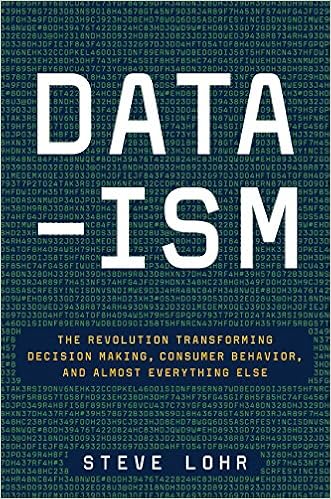
Lohr, Steve (2015): Data-ism - The Revolution Transforming Decision Making, Consumer Behavior, and Almost Everything Else

What is it about?

The book is, loosely speaking, about big data and its various possible and actual uses in different walks of life, especially in business. Data-ism basically refers to the all-pervasive importance of data especially in the future -- to the tune of "data is the new oil".

The book quite welcomely also includes ethical discussions, especially towards the end of the book, about how much data about our activities in, say, in the Internet can reveal about our preferences - including such preferences which we are unaware ourselves.

The book is quite heavily built around case studies, which for the most part travel with the author throughout the book, from theme to theme. In addition to the case studies, the book also includes general discussion and technology description, but it most often is motivated by an opening case.

Was it good?

The book has its merits and its drawbacks. On the plus side, the book is quite accessible and well-balanced overview of how data can be put into use in different walks of life, and what potential problems this brings about or has brought about. The case studies are also quite interesting and serve a clear purpose.

However, I increasingly like the "make it vivid" style of writing in general audience non-fiction books. In this book, for example, the descriptions of the outer appearances of featured people is striking to a degree of being annoying. Who cares, what is the texture of someone's moustache and how it plays along with the colour of his tie, if one wants to read about predicting customer behavior with social media data.

The main take-away for me?

The main take-away perhaps once again is the increased appreciation of what can be done with data, and how many applications there are for data accumulation, processing and consequent decision-making.

Who should read the book?

The book on Amazon.com: Data-ism

Friday, April 14, 2017

Scahill, Jeremy (2016): The Assassination Complex - Inside the Government’s Secret Drone Warfare Program

What is it about?

The book describes how the U.S. government employs so-called drones, or unmanned combat aerial vehicles, in various countries to eliminate - kill - people deemed dangerous to the USA or, quite vaguely, its interests.

Instead of a start-to-finish narrative, the book is a compilation of articles written by different authors, some of whom remain anonymous.

Apparently quite a bit of the contents of the book is based on leaked government/military documents, including some released to the public by Wikileaks.

Was it good?

The book is highly fascinating. The book quite naturally describes how the drones are technically used (e.g. how cellular telephone identities, signals and location data is highly important for target identification and missile guidance; how a satellite relay station in Germany is evidently a crucial data transmission link between the drones in Africa and the Middle East and their operators in mainland USA).

However, in addition the book includes quite illuminating discussions about the legal status of and issues involved in using drones in areas which are not designated war zones, and their use to basically assassin people without any legal process (e.g., a president's order suffices).

The main take-away for me?

The main take-away for me was a greatly heightened understanding of how drones are being used in a technical sense and an appreciation of all the questions, problems, gray areas (and black) and so on which essentially remain unresolved and to a degree undiscussed by the public at large.

Who should read the book?

I am quite confident that anyone with any interest in international or U.S. politics should read the book. Moreover, the book is bound to make one think also more broadly about how efficiently and effectively people - we - can be monitored through the the technology we use every day.

The book on Amazon.com: The Assassination Complex

Sunday, April 9, 2017

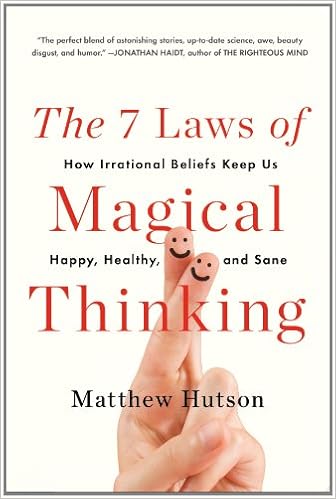
Hutson, Matthew (2013): The 7 Laws of Magical Thinking - How Irrational Beliefs Keep Us Happy, Healthy, and Sane

What is it about?

The author intends to provide a "popular" overview of magical thinking in its many forms.

Here, magical thinking is understood very, very broadly and quite synonymously with irrationality. For example, any sentimental feelings (e.g. valuing one's original wedding ring more highly than another identical ring) are classified as "magical thinking" by the author.

The author argues that everyone of us engages in magical thinking. The assertion is easy to accept given the exceedingly encompassing understanding of what constitutes magical thinking.

Perhaps more interestingly, the author argues that magical thinking is beneficial. In a number of cases this is thought-provoking (e.g. connecting with past in terms of the historicity of objects), but the author robs a bit of content from this assertion as well by including, for example, cognitive heuristics, in magical thinking.

Was it good?

I appreciate the basic setup of the book. Moreover, the book is quite nicely written, and reads well because of, for example, because of a high number of examples of the varieties of magical thinking discussed.

However, the highly broad conception of magical thinking inflates the capability of the book to deliver. In my opinion, sentimentality and cognitive heuristics and biases should have been left out, because I understand those to constitute somewhat different phenomena than magical thinking. Moreover, there are excellent books on those subjects already, whereby their treatment in this book pales in comparison.

The main take-away for me?

Perhaps as a result of reading the book, I "observe my thinking" more critically. However, I'm not sure what I should do differently in terms of my behavior. Should I try to value my wedding ring less? Or be grateful that I'm capable of assigning this additional "magic" value to it? Hard to tell.

Who should read the book?

Since the book is so encompassing and "general interest", it's difficult to think of a particularly fitting target audience for the book. Perhaps if one likes popular books on psychology, one would enjoy this one as well.

The book on Amazon.com: The 7 Laws of Magical Thinking