Thursday, December 29, 2016

Close, Frank (2004): Particle Physics - A Very Short Introduction

What is it about?

Like all titles in the Oxford University's "Very Short Introductions" series, this one too is true to its title: it provides a general overview of particle physics including the history of the discipline (how we came to know what we know today), and what are the experimental bases for the current state of knowledge.

Quite welcomely, the book concludes with some forward-looking thoughts, some of which have already come to fruition, such as the (quite likely) discovery of the Higgs' boson.

Was it good?

With only very general prior knowledge about particle physics, I appreciated the opening and closing sections of the book, which were more contextualizing by their nature. However, the rest of the book was a bit too technical for my liking. That is, I find it hard to maintain keen interest in reading which particles combine to form which particles, or which particle disintegrates into which new particles, or learn about the spins of various particles.

The main take-away for me?

Once again, the main take-away from the book for me is a meta one. Namely, it is quite astonishing as to what kind of and how much knowledge physics and chemistry has created. Indeed, some of the assertions of modern-day physics - taken for as "known" facts - are significantly more astonishing than any religion has managed to produce, such as elementary particles comprising superstrings existing in 10 or 11 spacetime dimensions, some of which are curled so intensely that we can't observe them. Furthermore, it is quite remarkable that we (or most of us), including myself, accept such assertions as scientifically established facts. I mean, science is quite wonderful in so many ways, and therefore quite a curious social phenomenon as well.

Who should read the book?

This book clearly is not for everyone. I doubt whether I fall into the target demography either. Thus, I presume that a keen interest in physics or (hard) science in general is required to appreciate and enjoy the book.

The book on Amazon.com: Particle Physics

Chomsky, Noam & McChesney, Robert W. (2011): Profit Over People: Neoliberalism & Global Order

What is it about?

The book describes, discusses and criticizes the political doctrine or ideology known as neoliberalism.

The basic position taken by the authors is that this ideology is quite prevalent today, and that it is societally detrimental because it favors corporations, especially the big ones, and thereby the rich, while the vast majority of people are correspondingly deprived of wealth and political influence.

Was it good?

With regard to its subject matter, the book is quite good. Its basic message is highly resonating with respect to the world political situation today and with respect to Finland in particular. Especially insightful is the discussion about the illusion of there not being any alternatives to neoliberalism - an assertion quite frequently heard in the public discourse both here in Finland as well as abroad.

The style of the book, however, leaves something to be desired. First, I found the book somewhat disorganized. That is, for me, the argumentative progression did not seem to follow a structured build-up to major conclusions. And second, the writing style came across as quite "complaining", i.e. negative tone used throughout the text. Thus, a more dispassionate and/or "intellectual" rhetorical style would have been more to my liking.

This is not to say that the observations made in the book were not to the point - rather, that if made in a more structured and dispassionate way, those would probably have been even more forceful.

The main take-away for me?

I personally appreciated the "illusion of there not being alternatives", because this issue (or non-issue) is rather topical here in Finland at the moment. That is, the neoliberal political line usually states that X must be done, because it is the only possibility. According to the authors, this is an illusion created by the currently hegemonic status of the neoliberal doctrine.

Who should read the book?

This book, too, is quite healthy reading for everyone. However, perhaps a dose of "political awareness" is beneficial for appreciating and especially enjoying the text.

The book on Amazon.com: Profit Over People

Saturday, December 24, 2016

Pinker, Steven (2008): The Stuff of Thought: Language as a Window into Human Nature

What is it about?

The book is quite a multifaceted discussion on language/linguistics, theory/philosophy of action and cognitive psychology.

While such a disciplinary repertoire might seem quite challenging for a casual reader at first glance, the book is actually rather accessibly written and only occasionally resorts to technical language.

Pinker's basic message is that human behavior can be understood (better) if one understands the goings on of the language that underpin our behavior and/or through which we influence each other's behaviors.

Was it good?

The book is quite insightful and accessible at the same time, which may not be a given for an account such as this, which operates in the intersection of disciplines which may be quite complex in their own right.

Accessibility is greatly enhanced by Pinker's practice of employing examples frequently throughout the book.

All in all, both human behavior and everyday language can be better understood after reading this book - at least that's the case for me, since I'm not a seasoned/scholarly expert in any of the focal disciplines (though have resorted to a little bit of theory of action in my dissertation).

The main take-away for me?

For me, the eight chapter "Games people play" was the most rewarding and thought-provoking. Here, Pinker, building on established scholarship, discusses how our everyday language is quite complex and nuanced "game" of meanings, connotations, "between-the-lines" messages and so on. In other words, what we say (literally, that is), is often quite far away from the message that we actually convey and/or intend to convey and/or end up conveying.

Here, though, Pinker's treatment could have ventured a bit more explicitly and farther in to discourse analysis (where this train of thought may be more fully developed), but still I thoroughly enjoyed this chapter in particular.

Who should read the book?

The book is clearly intended for a general audience, but perhaps an ideal reader is someone who already has at least a nascent interest in linguistics, or "how people do things with words". In any event, this book allows one to better understand the "language games" we engage in all the time.

The book on Amazon.com: The Stuff of Thought

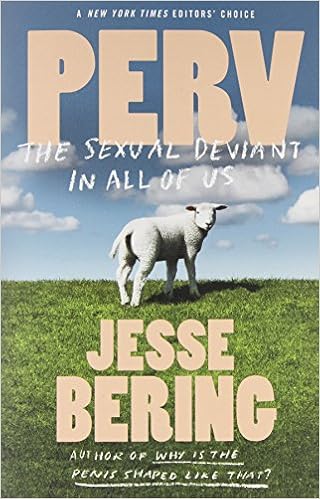
Bering, Jesse (2014): Perv - The Sexual Deviant in All of Us

What is it about?

The book intends to "demystify" human sexuality by exploring, without a coating of political correctness, the drivers and different varieties of human sexual behavior.

The basic message Bering evidently is intent upon putting forth is that what normal people in their normal discourse talk about as being normal sexuality (if the topic may be discussed at all) is quite far away from the actual sexual behavior that even the most "mainstream" people actually engage in.

Thus, Bering quite reasonably argues, practically every person is a pervert, or perv for short, if compared against this politically correct (and unreasonable) standard.

In addition, Bering covers a vast repertoire of various fetishes, which makes quite interesting reading as well.

Was it good?

The book is quite good: at the same time it is written in a very light and amusing style (though sometimes one may perceive the constant stream of jokes and puns even slightly excessive) and manages to be rather informative from start to finish.

After having read the book, I found it to be quite difficult to disagree with what Bering argues, i.e. that even the most normal of us "harbor secrets" with regard to our sexuality, if compared against the standards we assume in our everyday conversations.

The main take-away for me?

Put shortly, Bering's main messages are quite loud and clear, as noted above.

Who should read the book?

I think that it would be quite healthy that everyone read this book - especially the uptight (or "flower-hatted women", as they are proverbially called here in Finland) and those who have a hard time accepting that some people have sexual orientations different form their own. I believe that our society would a bit healthier in terms of its social interactions as a result of everyone having read this book.

The book on Amazon.com: Perv

Tuesday, December 6, 2016

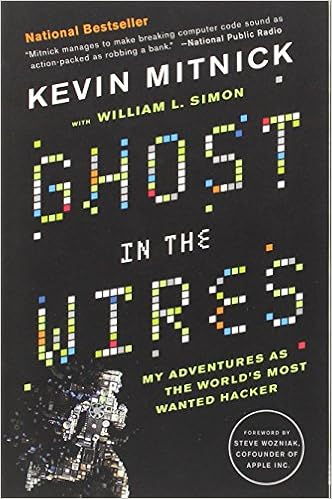
Mitnick, Kevin & Wozniak, Steve (2012): Ghost in the Wires - My Adventures as the World's Most Wanted Hacker

What is it about?

The book covers the life of Kevin Mitnick, perhaps the best known telephone and computer hacker in the world. The story is told in the words of Mitnick himself, and therefore offers quite a fascinating "insider's view" on how a hacker works, and what makes him or her tick.

The book focuses heavily on Mitnick's hacking activities - relying quite much on "social engineering" (i.e. persuading people to do things for oneself) instead of technical hacking - and his avoiding of law enforcement until his major arrest and conviction in mid 1990s.

Was it good?

The book is highly interesting, for a large part thanks to Mitnick's descriptions of how he pulled off various hacks, often relying heavily on social engineering.

The book also paints a very insightful picture of how the mind of an (ethical) hacker works. In a nutshell, an ethical hacker - such as Mitnick - is after "trophies" and enjoys accomplishing hard hacks as such, instead of seeking any economic or other such gain. Moreover, in the hacking scene, there seems to be (or has been) a social hierarchy wherein hackers hack each other - and a disgruntled fellow hacker eventually was indeed instrument in capturing Mitnick at the end of his hacking career.

The main take-away for me?

I was quite surprised to realize how much top-notch hackers rely on social engineering, i.e. persuading people to grant user credentials, tell proprietary information etc., and how much advance studying such social engineering often requires (e.g. studying organizational charts, rehearsing a role etc.). Mitnick, for example, could have never accomplished even a half of his hacking without social engineering.

Another take-away was the relization that we human beings are very, very vulnerable to social engineering - all it takes is for someone to put forth a plausible story on the telephone and often we're in.

Who should read the book?

I think that every computer (or more broadly technology) enthusiast would enjoy the book immensely - especially those who remember and relish the "Commodore 64 years".

The book on Amazon.com: Ghost in the wires

Sunday, November 27, 2016

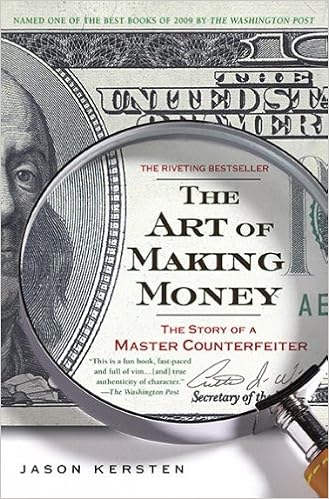
Kersten, Jason (2010): The Art of Making Money: The Story of a Master Counterfeiter

What is it about?

The book is a biographical account of the life of Art Williams, a U.S. counterfeiter, until about 2005.

The story covers Williams' life from the early, quite rough and deprived childhood, through his years of counterfeiting U.S. money (esepcially 100-dollar bills), escaping the U.S. Secret Service to Alaska and eventual fall, or actually two major arrests.

The epilogue of the book is not too delightful reading, since Williams was in the brink of what looked like a successful legitimate career as a document security expert, consultant and public speaker, but was forced to give it up because of objections from his parole officer. This, in turn, lead into making counterfeit money again, and arrest.

Was it good?

The book certainly is very good; the chronologically progressing narrative is very professionally and compellingly written making it hard to put the book down for a while. Moreover, the narrative style in which the book is written, one is bound to "take the side" of the main villain, Mr. Williams.

What perhaps could have been featured more prominently was the technical aspects of designing and making the counterfeits, and the technical hurdles that had to be overcome. There understandably may be some legal obstacles for disclosing such information, perhaps especially in the USA, but still even some not-so-accurate technical-methodological descriptions would have been a welcome addition, because these would have portrayed the actual undertakings and prowess of Williams in a more appreciable way.

The main take-away for me?

Although the book does not discuss it it at length apart from some brief references in the beginning, the book nicely - though mostly unintendedly - problematizes the modern notion of money. In fact, the book in a way complements the Austrian Economics view on modern "fiat" money, which basically states that what today passes as money is what a government says that will pass as money - a somewhat problematic notion, or at least a bit risky.

Who should read the book?

The book is of quite general interest, though those with an interest in economics - whatever the persuation - probably will enjoy the book the most, because it allows one to ponder about some "meta" issues with respect to the nature of money while reading along.

The book on Amazon.com: The art of making money

Thursday, November 24, 2016

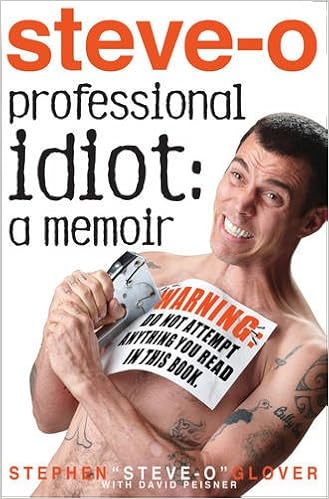
Glover, Stephen Steve-O (2012): Professional Idiot - A Memoir

What is it about?

The book tells the story of Steve-O, i.e. Stephen Glover, a member of the Jackass group until about the year 2001.

The book is autobiographical, covering Glover's quite eventful life from his own perspective.

The book may be thought to consist of three chronologically sequential themes, which all play a distinct part in painting the whole picture: childhood, the "stunt years" (i.e. including the Jackass career covering the two first movies), and sobriety following a mental (probably to a large part due to quite voluminous drug use) breakdown and subsequent institutionalization.

Was it good?

The book is quite breathtaking and engaging reading.

This is partly because of the drug- and mayhem-infused "stunt years" which make one to just wonder that Glover is still alive let alone reasonably healthy.

However, the book is - either intentionally or unintentionally - constructed so that the "third part", i.e. recovery and sobriety, makes all the preceding text to be seen in a completely different light.

Thus, what comes across as a narrative of outrageous irresponsibility up to about 75% of the book, in the end actually turns out to be a book about life values - and a quite contemplative account in that.

The main take-away for me?

I just can't say anything else than to admit, that the "third part" made me really contemplate life in general and - of course - my life in particular.

Somehow the feeling the book provides is that it is really difficult to appreciate what one has (what could perhaps be called as normal life) until it no longer is there. That is, it is often too easy to take things for granted.

Moreover, Glover's reflective discussion throughout the book about his dependency on attention from others certainly makes one think about the current buzz around social media, self-branding, "attention economy" and so on. In fact, if one feels that one may have a dependency problem (or any such problem) with social media, this is certainly one book to consider reading.

Who should read the book?

While the book is of quite general interest, I think that the book is exceptionally good reading for anyone suffering or recovering from a dependency of any sort; the book describes quite graphically both the highs and the lows, and a path onto solid ground in the end.

The book on Amazon.com: Professional idiot