Wednesday, September 7, 2016

Funder, Anna (2011): Stasiland - Stories from Behind the Berlin Wall

What is it about?

The author reports about her encounters with people who lived in East Germany (i.e. GDR; German Democratic Republic) until its collapse in 1989-1990. More importantly, the author "tells the stories" of her informants as shared with her, which provide highly interesting windows into the everyday life in East Germany - in practice a police state.

Was it good?

I struggled a little with getting into the pace and narrative style of the book - the book is presented as case narratives within a larger autobiographical narrative - but after getting used to it, I really enjoyed the book.

Thus, at least for one not terribly familiar with the subject matter, the book offers a selection of quite captivating stories about what it was like to live in a police state "behind" the iron curtain. Moreover, the informants include both ordinary citizens as well as ex-Stasi officials.

The main take-away for me?

While the "this is how it felt living in a police state" narratives are interesting, perhaps the most intriguing aspect of the book was offered by those informants who perceive the "free" societal order as not preferable to the police state. Admittedly, there is a lot of nostalgia and selective forgetting going on there, but some of the aspects raised by the interviewees (e.g. lack of theft and other mundane security threats, affordability of various state-provided services etc.) are abound to make one think about what makes a society a good one. But then, all this and more can be accomplished by John Rawls' "Veil of ignorance".

Who should read the book?

I think that the book is beneficial for the younger generations who have very little if any connection, exposure or recollection about quite different societal orders - especially so that they would exist in the very heart of Europe. While fictional works such as Orwell's 1984 are highly illuminating, true stories have quite a different flavor to them.

The book on Amazon.com: Stasiland

Monday, September 5, 2016

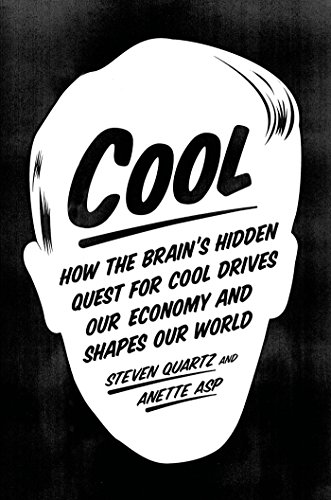
Quartz, Steven - Asp, Anette (2015): Cool - How the Brains Hidden Quest for Cool Drives Our Economy and Shapes Our World

What is it about?

The book basically (though at places somewhat implicitly) says that the "traditional" microeconomic homo economicus is a gross oversimplification of human (economic, consumption) behavior.

Instead, Quartz argues that purchase and consumption choices are inherently social psychological phenomena. In other words, we all, e.g., signal aspired identities and group memberships through our choices of what products (or services) we purchase, adopt, use and discard.

Moreover, Quartz quite sensibly - and with substantial backup from disciplines such as evolutionary biology and psychology and neuroscience - argues that in many cases there is very little we can do about this; such behavior is hard-wired in us through evolution.

Was it good?

The book is good indeed, though in my case Quartz is "preaching to the converted".

Perhaps the most distinguishing feature of the book is its exceptionally broad disciplinary scope, as noted above. This, in a way, is a double-edged sword. On the one hand, drawing support from a broad range of academic research domains certainly adds weight and credibility to the arguments Quartz advances. But on the other hand, such multifaceted discussion may at places come across a little heavy for the reader ("a bit less would have sufficed").

But all in all, the book is - because of this distinguishing feature - a wonderful learning experience.

The main take-away for me?

While I never have denied the invalidity of homo economicus model, the book certainly made me pay a lot closer reflective attention on my own purchase and product use behavior. As a result, I'm certainly more cognisant about "what do I signal" with what I wear and use, though my own perception about this may be quite different from what another person would think.

Who should read the book?

Once again, I believe that most people should read the book. The book is not anti-consumerism by any means, but I sincerely believe that most people could be "better" (also more economical) consumers if they were a bit more reflective about their consuming habits; i.e. why they consume what they consume.

The book on Amazon.com: Cool

Snow, Richard (2014): I Invented the Modern Age - The Rise of Henry Ford

What is it about?

The book basically tells the story of Henry Ford, from his early childhood until his death in 1947.

However, the book is not a basic biography, but focuses on his contribution to the invention of the automobile and, perhaps more importantly, the "modern age", including mass production, standardization, economies of scale and even urban culture.

Was it good?

For me, not having ready any other Ford biography, the book is highly fascinating. The book not only describes how the internal combustion engine automobile and industrialized mass production came to be, but also sheds light on the mindset of Ford and his colleagues who brought all this about (including Ford's contemporary competitors).

In particular, it became very obvious that it did not suffice by any means for Ford to be in teh right place at the right time, but in addition he expended significant effort in inventing some key technical constructions (such as the carburettor), conducting important publicity stunts (e.g. in early car racing) and organizing for efficiency and scale.

Towards the end, it also highlights the mental - and some organizational - inertia towards quite necessary renewal.

The main take-away for me?

Like some other inventor-innovator-related books, the main take-away here for me is that the right idea is just a start: in addition to that there must be a lot of hard work to bring the idea to fruition. Thus, some short journalistic accounts on new innovations or innovators often do not do justice on all the work that takes place "behind the scenes".

Who should read the book?

I think that the book is of quite general interest, and it is certainly written in such a way that basically anyone can enjoy it. However, those interested in cars, (history of) technology and engineering in general probably will enjoy the book the most.

The book on Amazon.com: I invented the modern age

Monday, August 22, 2016

Nevanlinna, Tuomas (1999): Hyväkuntoisena Taivaaseen (in Finnish; transl. "To Heaven, in a Good Shape")

What is it about?

This is a book written by one of my favourite philosophers (though not a professional academic one), Tuomas Nevanlinna, one of the discussants in the light-mooded (or even humorous) philosophical radio program, Tukevasti Ilmassa (transl. "Firmly in the Air").

The book directs a philosophical gaze on everyday life, and makes very poignant and compelling observations. As a read thread that runs through the book, Nevanlinna's style (and way of thinking) is characteristically dialectical; often for there to be something, there also has to be its opposite. For instance, for something to be original, there must be imitators, even though original roughly means "the first one" (before there were any imitators). In other words, it is only the imitators which make something original.

As much as the book is a philosophical discussion about various everyday phenomena (e.g. air travel, sports, technological development and consumerism, love, education etc.), it is quite sharp social commentary.

Was it good?

The book is, in my opinion, supremely good, and is quite faithful to Nevanlinna's characteristic writing/speaking and thinking style.

I especially like the great variety of topics under discussion, and the often surprising points of view which Nevanlinna takes and then provides rather compelling argumentation to back those up if not to show that other perspectives seem even unthinkable.

For an everyday/common reader (i.e. outside the academic philosophical circles), this is what philosophy should be.

As an example, here is a passage from page 254 (freely and quickly translated by me; emphases in original):

"One of the defining features of European culture is despise towards and dismissing of material artefacts.

Our relationship with material artefacts is defined and maintained on the other hand a technological-economical complex (according to which material artefacts are taken as discardable or replaceable), and on the other aesthetics (according to which material artefacts are, in the end, in the mercy of our individual meaning-giving).

According to both perspectives, material artefacts don not mean anything in and of themselves.

What is annoying with regard to the prevailing culture is that material artefacts, after all, are meaningful for people in ways which are not exhausted by usefulness or sensory pleasure. For example, personal, "dear to me", mementos. One does not really deny the justification of this kind of a relationship to a material artefact, but it is valid only within the dark mazes of privacy.

Why? Because science teaches us that material artefacts "as such" do not mean anything. Their experiential meaning is a consequence of either a juvenile transfer of emotions, or an arbitrary judgment of taste. Furthermore, material artefacts do not live, "suffer", and therefore one can treat them in any way one pleases.

Humanists are against objectification of a human being. Feminists criticise objectification of women. But why does not anyone speak about objectification of material artefacts?" (p. 254)

Here, there is at the same time something to think about, and a quite humorous take on the World.

The main take-away for me?

The applicability and usefulness of dialectical thinking really struck me while reading the book, and I certainly intend to "direct such a gaze" to the everyday life -- like Nevanlinna has done here.

Moreover, Nevanlinna really shows that one does not have to be entirely serious in order to be insightful and compelling.

Who should read the book?

Perhaps the book is a bit too "high-flying" for a random reader, but if one has any philosophical bent or curiosity, here's a prime example of "philosophy put to real work".

The book on Goodreads.com: Hyväkuntoisena taivaaseen

Sunday, August 21, 2016

Weldon, Glen (2016): The Caped Crusade: Batman and the Rise of Nerd Culture

What is it about?

The book "tells the story of Batman" (the phenomenon, not only the figure) and with the help of that, and importantly, provides a cultural historical study of fandom, or nerd culture. In the case of this book, by nerd is understood a personality very, very close to that of the Comic book guy in the Simpsons, and not a computer geek.

It becomes quite evident that while the authors and publishers of Batman (like any other such comic and later movie franchise) have always been very responsive to changes in the surrounding societal and cultural environment (driven by the profit motive, of course), the increasing adoption of the Internet has made fans -- and also the more general audience -- an increasingly influential stakeholder in movie and comic production even to the degree of movie scripts being altered during shooting in reaction to discussion forum outrages.

Was it good?

While I'm not a Batman or comics fan by any means, the book works very well at both levels: in telling the Batman story (how the figure and the stories have reacted to changes in cultural "mood", thereby reflecting societal conditions) and especially discussing the "history and increasing prominence of the nerd".

The book is quite significantly tilted towards covering the history of Batman, but regular short and reflective discussions about "what this tells us in cultural terms" well justify the ample Batman content, and make the book actually come across quite balanced.

The main take-away for me?

While it should not have been as a revelation, it still quite astounded me to realise how overly engineered comic book characters, comics and movies are. Namely, even some of the very fundamentals in a character's "origin story" can be readily abandoned in the interest of sales. For example, the early Batman, to my surprise, even engaged in time travel and battles in parallel universes...

Who should read the book?

Quite obviously the book is very likely to appeal to any Batman or superhero fan, or a proud (or insecure) nerd. However, I think that the book should also be ready by anyone who perceives superheroes or comics or movies featuring them childish, non-serious and/or a waste of time.

All in all, I really enjoyed the book and can quite readily recommend it -- also as study in cultural criticism.

The book on Amazon.com: The caped crusade

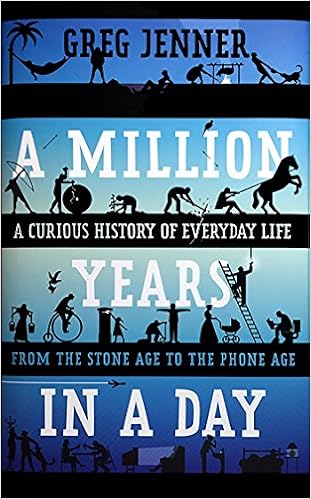
Jenner, Greg (2016): A Million Years in a Day: A Curious History of Everyday Life from the Stone Age to the Phone Age

What is it about?

The book traces the history of everyday practices and artefacts (such as toothbrush/dental care, beer, clock/measuring of time, beds etc.), built around a framing story of spending a Saturday from waking to going to bed.

Thus, the book has an organizing timeline, with the help of which the author discusses quite a number of "thematic case histories" of "how things developed to be as they currently are."

Was it good?

The big idea of the book is very fascinating: really pondering, for example, why our clocks seem and work as they do (e.g. why there are 60 minutes in an hour). The "thematic case histories" are well chosen and discuss -- at least to me -- quite interesting issues and historical developments.

On the other hand, however, the writing style is from time to time quite irritating -- that is, again, to me.  For example:

"This, of course, finally led to the English alphabet of 26 letters, which I am currently using to bore you to tears. Sorry about that. Anyway, to make it really simple, without the Phoenicians there would be no 'Alphabet Song' on Sesame Street, and I think we can all agree that would've been a tragedy."

Thus, if the book would have been written in a more neutral, factual style (or more mindfully humorous), I would have enjoyed even more.

The main take-away for me?

I was quite astonished as to how advanced the ancient Roman and Greek civilizations were in terms of technology. For example, their centralized and public water and sanitation services and technologies -- already some 2000 years ago -- allowed for water on the tap and variously heated swimming pools in public baths. Thus, human ingenuity has flourished for a very, very long time already.

Who should read the book?

I think that the book is of quite general interest, but the writing style is off-putting to such a degree, that I would recommend the book only if the subject matter seems highly appealing to you.

The book on Amazon.com: A million years in a day

Thursday, August 18, 2016

Diamond, Jared (1997): Guns, Germs, and Steel: The Fates of Human Societies

What is it about?

The book has a very ambitious goal: it attempts to explain the course of human history (in broad outlines) during the past 13 000 years or so.

More specifically, the book aims to answer "Yali's question" (a question posed to the author by a prominent politician in New Guinea): why Europeans conquered native Americans and not the other way around? Or, why some peoples and some cultures developed "further" and more rapidly than some others?

The author gives a very clear-cut answer to this. It's NOT about inherent differences in human ability, but rather about what different environmental settings afforded. This is the "deep" answer -- argued into existence very carefully and convincingly, and backed up by a lot of scientific evidence. There may be some more superficial answers (e.g. with regard to technology, language, governance structures etc.), but these are only proximate causes, all going back to the "deep" answer.

Was it good?

The book is just superb. Not only is it insightful and credible, it is also highly informative and entertaining in a lighter sense. Put shortly, the book is delightful to read throughout.

Moreover, the author must be applauded for the breath and depth of his knowledge; the scope of expertise required for writing a book like this is immense.

The main take-away for me?

The book really highlights the fact that we human beings tend to focus on quite shallow (or proximate) explanations for phenomena, whereas in most cases there probably is a "grander", "deeper" mechanism (or a bundle of mechanisms) at work. At the same time, however, this is not very surprising, because evidently uncovering such "grand" mechanisms is no small feat.

Who should read the book?

I would recommend the book for anyone; both the message and the style should be very generally appealing.

The book on Amazon.com: Guns, Germs, and Steel