Saturday, July 15, 2017

Solomon, Scott (2016): Future Humans - Inside the Science of Our Continuing Evolution

What is it about?

This book is - at least with respect to its basic setup - about two things: (1) whether and how the human race still evolves (per biological evolution; natural and sexual selection), and (2) how this evolution could unfold in the future.

The bulk of the book is devoted to discussing different mechanisms of biological evolution with numerous examples from human history as well as from the animal and plant kingdoms more generally. In addition, the book quite convincingly makes the case that despite "modernization", biological evolution has not stopped in the human race; e.g. genetic evolution through sexual selection may be even more pronounced today as it has been in the past because people move throughout the globe in increasing numbers and therefore mixing of different gene pools happens in greater extend than ever before.

However, the "future humans" content - despite being prominently featured in the book title - is very, very thin. Yes, the author discusses the mechanisms through which future evolution may play itself out (e.g. the effects of diminishing exposure to various beneficial and harmful bacteria in the post-industrial Western world), but there is quite little "end results" speculated about.

Was it good?

My feelings towards the book are mixed. In a way, the book very nicely builds towards the main deliverable: what future humans would be like - the conceptual-theoretical-empirical foundation is very solid.

But then, the main deliverable does not really materialize, which is something of a disappointment. At least I expected to read towards the end of the book about whether we would have, say, larger heads (brains), evolve into several different species and so on, but apparently the author has not dared to venture into such speculations -- the book is published by Yale University Press.

But, in this case perhaps it would have been more honest towards the reader to drop the notion of "future humans" from the title, as the book does not really paint a picture of future humans -- though it excels in spelling out the mechanisms which will bring about those future humans.

The main take-away for me?

Perhaps the main take-away for me was - perhaps a bit paradoxically - how little we know about genetic mechanisms. According to the book, in very many cases it is well-established that genetic mechanisms are responsible for evolutionary outcomes both in short and long term, but next to nothing is known today how those mechanisms precisely operate.

Who should read the book?

The book, in my opinion, should be considered mostly as a good popularized introduction to evolutionary biology and not a account on how future human beings will look like. Conceived like this, the book can be recommended to anyone interested in evolutionary biology. But then again, in this category there probably is not a shortage of excellent popularized accounts, such as those authored by Richard Dawkins, for example.

The book on Amazon.com: Future Humans

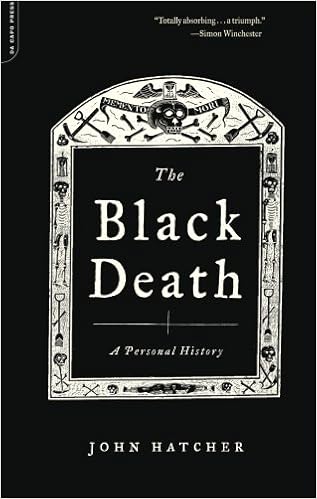
Hatcher, John (2009): The Black Death - A Personal History

What is it about?

This is a curious book. It is written by a professional historian, but is written as a "semi-fictional" story. That is, the story running through the book is fictional by nature, but it is written as far as possible based on historical facts.

The book is situated in Suffolk, Great Britan, in the rural parish of Walsham le Willows, for which there are excellent historical records available for the focal period of 1340s to 1350s. Consequently, the characters and other contextual aspects can be based quite well on historical facts such as court records.

The story is told with the parish priest, Master John as the main character. Consequently, the perception by the common people towards the pestilence appear quite theological in nature -- which well might have been the case in the absence of modern medical knowledge. However, there voice of the story is that of an external narrator.

Welcomingly, each of the chapters begins with a non-fictional contextualizing section, which provides the current historical knowledge of the issues presented in the fictional story in the chapter.

Was it good?

The book is fascinatingly set up due to the "semi-fictional" style. Moreover, the historical-factual sections at the beginning of each chapter clearly add value and more generally make the story more compelling.

Actually, the historical-factual sections make even better reading than the fictional story itself. Namely, it is somewhat evident that the author is not very experienced with writing fictional narrative -- for example sometimes the narrative reverts to the form of "this happened, and then this, and thereafter also this" without much nuance and vividness.

Overall, however, the book paints a compelling and interesting picture of what it was like to live through the black death (or one instance of it) during the Middle Ages.

The main take-away for me?

The main take-away for me is probably the vast difference in world view between us today and the people living in the Middle Ages. Namely, if the book is to be believed, fortunes and misfortunes were explained during the Middle Ages to a large degree theologically, and consequently prayer and all kinds of religious rituals were primary in combating, say, a pandemic disease -- which, from the modern Western post-industrial standpoint is largely if not entirely futile.

Who should read the book?

I think that anyone interested in the black death of the Middle Ages more in general would find the book quite interesting. However, if one seeks a thoroughly enjoyable fictional story to read, this book may not be the prime choice to make.

The book on Amazon.com: The Black Death

Dunn, Rob (2017): Never Out of Season - How Having the Food We Want When We Want It Threatens Our Food Supply and Our Future

What is it about?

The book on the other hand provides a historical account of how our food supply has developed since the start of agriculture until today (more efficiency, less variety) and on the other hand sounds the alarm concerning how the current overly engineered and focused food supply is also highly risky.

The risks stems from a high degree of reliance on just a handful of crops (and within those, just one or two varieties with highest yields), because a problem with a particular crop such as rice or corn (e.g. a pest or a plant disease) could significantly hurt the food system in its entirety.

The book contains a number of alarming examples - such as the potato famine in Ireland in the 19th century - in which cases serious problems or even deaths due to hunger resulted when one major food source was attacked by a pestilence such as the late blight disease in the case of the Irish potato famine.

Was it good?

The book is a good balance between historical case narrative (with which it opens, too), review of current biological knowledge and informed prospects, and sounding of alarm.

A book like this may quite easily cross the line between "reasoned worry" and "alarmism", but this book stays within the reasoned category.

The historical narratives, for me, constitute the best contents of the book. For instance, the protection of potato varieties for future planting purposes in an agricultural institution during the siege of Leningrad in the 1940s was highly fascinating to read -- some of the personnel practically died of hunger while protecting perfectly edible potatoes and other plants because they wanted to preserve those for future people to plant.

The main take-away for me?

Well, the main message of the book has to be the main take-away; that we are creating increasing risks by building our food supply around ever fewer food plants -- we are placing our eggs increasingly in one basket.

Who should read the book?

The book on Amazon.com: Never Out of Season

Tuesday, July 4, 2017

Deary, Ian J. (2001): Intelligence - A Very Short Introduction

What is it about?

This is one of the books in Oxford University Press' Very Short Introductions series; this time on intelligence.

The book basically sets out to provide an accessible overview of what we (the scientific community) know about intelligence as a result of more than a century of research on the subject.

The book opens with a methodological discussion (an excellent primer on basic statistics) followed by a first proper chapter on the definition of intelligence (or intelligences according to some accounts).

Quite a bit of the about 120 pages is devoted to the "nature vs. nurture" discussion, i.e. whether genes or the environment matter more for a person's intelligence. There seems to be no definite conclusion yet, but I got the impression that they are roughly speaking equally important.

Was it good?

The book is very accessible, starting from the opening discussion on basic (psychology research) statistics. Throughout the book, the discussion is very down-to-earth even though the contents are drawn from academic research, and in many cases in large scale meta analyses covering decades of scientific research.

The style of the book is notably calm - fitting to a book by an academic publisher - even to the degree that it is quite difficult to draw any memorable punchlines or main messages from the text.

The main take-away for me?

I was most intrigued by the discussion about how intelligence - or mental abilities in general - develop and persist over time (mainly chapter 2). It turns out - again based on rigorous empirical scientific research - that most mental capabilities don't deteriorate (absent any detrimental medical condition) from the 20s to 30s until somewhere in the 70s or later. Those which do deteriorate mainly have to do with the absolute swiftness of information processing.

Thus, in general terms, people don't become less intelligent even very late in their life.

Who should read the book?

I would recommend the book for anyone who is interested in intelligence - what it is, how it develops and how we can study it. However, this interest should be somewhat 'serious' because the book does not deliver catchy one-liners but rather syntheses of academic findings.

Saturday, June 17, 2017

Lipson, Hod (2016): Driverless - Intelligent Cars and the Road Ahead

What is it about?

This book is about autonomous cars - their past, present and future.

However, the book not only discusses autonomous cars themselves, but to quite a notable degree covers the underlying technologies as well. Perhaps the most notable such examples are artificial intelligence and especially "deep learning", machine vision (with optical, laser and radio technology) and computer and software technology in general.

In addition, the authors very welcomingly discuss also the derivative social effects which would result from widespread adoption of autonomous cars (e.g. loss of certain jobs, changes in urban landscape, economies of urban, sub-urban and rural areas etc. Furthermore, the book does a good job in discussing some of the most obvious ethical questions such as how to value human life, because such a value is needed when an autonomous vehicle is in an emergency situation forced to choose between two or more courses of action all of which involve fatalities and/or damage to property.

Was it good?

The book is very interesting and reads quite well. At places, the authors get close to that stylistic line which irritates me in contemporary non-fiction books (overly colourful language, hyperbolic analogues etc.), but don't get there.

I especially appreciated the extended discussion on underlying or enabling technologies (e.g. how a neural network works, what affects its performance and how this have developed over the past decades, and how neural networks can be and are being employed in machine vision/sensing such as in autonomous vehicles), as this gives one a substantially deeper understanding about the current state and foreseeable future of autonomous cars.

Moreover, I equally liked the discussion concerning societal and ethical issues. This, actually, sets this book apart from may other contemporary non-fiction books especially on technical subjects, because the authors explicitly admit that there currently seems to be to much simplistic hype around autonomous vehicles.

The main take-away for me?

The main take-away for me certainly was an increased understanding about the technical complexity of making autonomous cars reliable and eventually "mainstream". For example, detecting a human progressing slowly while carrying a large dense object as human is very, very difficult to pull off with machine sensing. Yet, this must be routine with 99.9999% accuracy if autonomous vehicles are to become ubiquitous.

Who should read the book?

The book certainly requires some interest in the subject and an engineering mindset (neural networks, laser distance detection...), but anyone at all wondering about how advanced autonomous cars currently are and how (or whether) they become commonplace, should certainly read the book.

The book on Amazon.com:  Driverless

Wednesday, June 14, 2017

Line-In Publishing: Sociology - Exploring Human Society

What is it about?

This is a basic text on sociology, like a basic undergraduate textbook on "Sociology 101" course.

Hence, it starts with describing what sociology is (as an academic and intellectual discipline) and how sociological research is conducted, and then proceeds to discuss key themes in sociology such as the society, organizations and organizational behavior, the family, crime etc.

As a very notable feature, all the major topics are discussed through three sociological lenses: functionalist theory, conflict theory and symbolic interaction,

Was it good?

The book is extremely accessible - it discusses the topics in a very down-to-earth way and with no particular hurry or an use of highly specialized vocabulary. At times, this may convey a slowly progressing impression, but every once in a while I found myself really contemplating quite basic issues such as my conception of the family, or how very basic processes operate in my workplace. Thus, the very basic nature of the book actually turned out to be a benefit for me.

Moreover, the choice to run all the key themes through the three lenses - functionalist theory, conflict theory and symbolic interaction is a very good choice: in this manner all the themes appear in different light depending on which of the lenses one uses to look at issues.

The main take-away for me?

My take-away perhaps is at a meta level. Namely, that sociologists have accumulated quite a bit of well-reasoned and researched knowledge which is fully applicable but undervalued in many walks of life. For example, I would claim that at most workplaces people are perplexed by issues (say, for example, difficulty of making changes in work processes) which would be crystal clear and obvious for a sociologist - and even for a sociologist living half a century ago.

Who should read the book?

I would recommend the book for absolutely everyone. Especially if one has not studied sociology before, this book is a stellar place to start.

The book on Amazon.com: Sociology

Wednesday, May 31, 2017

Lefèvre, Edwin (1923): Reminiscences of a Stock Operator

What is it about?

The book is a biography of a stock trader (or speculator), reportedly covering the life Jesse Lauriston Livermore.

The book is set in early 20th century (the book was originally published in 1923), and is organized chronologically and organized around highlight events (often particularly successful or unsuccessful or otherwise "teaching" trading campaigns).

Was it good?

The book is extremely good. Not only is it written in a very entertaining and personal style, but it also dispenses quite poignant observations of the human condition.

Indeed, one could say that the psychological observations of human nature and general psychological tendencies are the most valuable content in the book.

And even if one is not interested in any such observations, the book makes quite entertaining reading nonetheless.

The main take-away for me?

Besides the insights about inherent human psychology, a thought that I constantly kept on having throughout the book is "that wouldn't work today". And, in fact, the author (the narrator) admits in the very last pages of the book that his exploits had become increasingly difficult already in the 1920s: there was more stocks traded, more information to digest (impossibly much already in the 1920s), more stringent regulations on insider trading (a very central phenomenon in Livermore's exploits, though he himself was not an insider) and so on.

In any event, the book illustrates very nicely how the speculators got their name and stereotypical character in the early 1920s: already then the speculators were wholly uninterested in the "real" economy, only looking for how the "stocks acted" for the purpose of turning a profit on stock price developments.

Who should read the book?

If one is at all interested in financial economy and the stock market in particular, reading the book - despite its peculiar historical context - is time most assuredly time well spent.

The book on Amazon.com: Reminiscences of a Stock Operator

Graeber, David (2014): Debt - The First 5,000 Years

What is it about?

The book describes how people have perceived and interacted through debt until about early 1970s, from the start of recorded history.

The book most certainly has an agenda. This agenda is to suggest that the modern notion of debt, an impersonal numerically expressed money sum involving parties which have little to no personal connection, is an anomaly in the historical record.

Moreover, the author suggests that this calculating, impersonal and mathematical understanding has brought about all kinds of undesirable social effects such as greed, self-centeredness and so on. After all, according to the author, social relations are significantly more healthy if debt includes a social aspect even if debts are generally expected to be paid back in a way or another.

Was it good?

The basic setup, the main argumentative line, and the conclusions certainly are highly interesting, and the author's train of through and evidence-based reasoning is credible. One certainly can't miss the basic message or its support from the historical record.

However, delivering this message takes nearly 500 pages. That's a lot. Most of the pages are used for quite detailed historical descriptions from different eras, which to my taste started to be a bit too much to my taste.

Once again, this book too would be significantly more enjoyable, if the middle 400 pages were compressed into, say, 1/4 of their current length. If appropriately done, I can't see the basic message being diluted a bit.

The main take-away for me?

Well, I presume that the basic message of the book is the main take-away. Namely, how people perceive debt (like any institution or social convention) has significant societal effects. In the case of debt, when debt is being perceived as an impersonal mathematical construct, the morality concerning debt and economic behavior more generally is very different from a society where debt is between people who know each other and interact on a regular basis.

Who should read the book?

In its current form (length), it is not very easy to recommend the book - unless one reads just the first and last 50 pages or so, and cursorily scans everything between. In any case, the basic message is one which should be heard wide and far in the Western world, as it provides a nice contrast to how things are today - and shows that they could be otherwise too.

The book on Amazon.com: Debt

Thursday, May 4, 2017

Dormehl, Luke (2017): Thinking Machines - The Quest for Artificial Intelligence--and Where It's Taking Us Next

What is it about?

The book is an excellent and quite accessible overview of artificial intelligence, or AI (what it is, what approaches there are to AI, what AI currently can and can not do), including a historical overview of the origins and early developments of AI.

In addition, and importantly, the book has a good deal of forward-looking discussion about how AI conceivably could develop in the (near) future, and what kinds of questions this could bring about, especially with respect to ethics and legislation (e.g. responsibility questions in driverless cars).

Was it good?

I thoroughly enjoyed the book. The informational contents are - at least for me - in a good balance in terms of basics and "frontiers", and especially the case illustrations (e.g. IBM's Jeopardy-winning AI the Deep Mind) nicely make the discussion concrete.

However, what I really appreciated was that the author successfully resisted the temptation to launch into science fiction-like speculations towards the end of the book (through the notion of conscious AI, the singularity etc. were covered). Instead, all the future-looking and ethics-related discussion is firmly rooted in what current and realistically foreseeable technology could enable.

The main take-away for me?

After reading the book, I probably understand and appreciate more the "mundane" applications of AI (e.g. movie recommending systems, autonomous driving software), and how anticipated developments in the near future may influence our lives and force us to rethink to a degree the premises in our legal systems (e.g. what about if a credit screening system is found to discriminate against a group of people, but because the system is implemented with a neural network, nobody can discern how those credit screening decisions are made?).

Who should read the book?

If one is at all interested in information technology and "big data" or the topic of artificial intelligence in particular, but is not entirely sure what the fuss is about, this book is well worth reading.

The book on Amazon.com: Thinking Machines

Tuesday, April 25, 2017

Arbesman, Samuel (2016): Overcomplicated - Technology at the Limits of Comprehension

What is it about?

The basic position of the book is that the technological environment in which we live has become so complex that in many cases we no longer fully understand let alone control how technology works. Especially this is true in large technical systems such as the Internet, or electricity or water distribution.

Thus, complex technological systems exhibit emergent behavior which is at times surprising to us because due to their complexity, their behavior can not be modelled or otherwise anticipated in all possible circumstances.

As examples, complex technological systems cause phenomena such as sudden swings in financial markets (computerized systems trading by themselves at a very high speed) and large-scale electricity outages (a single failure causing a cascade of effects which diffuse system-wide).

According to the author, this "overcomplication" is to a part due to fundamental restrictions in our capacity to process and understand information, and to a part due to the very nature of complex systems/phenomena (c.f. complexity theory).

As a possible way to at least partly tackle the problem, the author suggests that we should increasingly view technology with biological rather than mechanistic metaphors.

Was it good?

The book is quite good and pleasant to read. Well, probably the contents could have been squeezed into one third if not even tighter with the basic message left basically intact -- North American non-fiction books for a general audience seem to suffer from a kind of a syndrome of "having to be of a reputable length".

In any event, the book contains a number of illustrative examples (stock markets, electricity grids, commonly-used software applications, computerized functionality in cars etc.), which make one to really appreciate what the author has to say.

The main take-away for me?

In a way, the book didn't include anything particularly new to me, which I assume to be the case if one is read anything touching on complexity theory and/or technological systems. In any event, the human side of the discussion (how we, as humans, may be inherently incapable of grasping large complex systems) was a welcome and refreshing addition to a "standard treatment". Also, the biological vs. mechanistic metaphors of viewing technological systems (though not worded in this manner by the author) was thought-provoking--the fundamental metaphors with which we view the world surely are quite consequential.

Who should read the book?

The book on Amazon.com: Overcomplicated

Monday, April 24, 2017

Lohr, Steve (2015): Data-ism - The Revolution Transforming Decision Making, Consumer Behavior, and Almost Everything Else

What is it about?

The book is, loosely speaking, about big data and its various possible and actual uses in different walks of life, especially in business. Data-ism basically refers to the all-pervasive importance of data especially in the future -- to the tune of "data is the new oil".

The book quite welcomely also includes ethical discussions, especially towards the end of the book, about how much data about our activities in, say, in the Internet can reveal about our preferences - including such preferences which we are unaware ourselves.

The book is quite heavily built around case studies, which for the most part travel with the author throughout the book, from theme to theme. In addition to the case studies, the book also includes general discussion and technology description, but it most often is motivated by an opening case.

Was it good?

The book has its merits and its drawbacks. On the plus side, the book is quite accessible and well-balanced overview of how data can be put into use in different walks of life, and what potential problems this brings about or has brought about. The case studies are also quite interesting and serve a clear purpose.

However, I increasingly like the "make it vivid" style of writing in general audience non-fiction books. In this book, for example, the descriptions of the outer appearances of featured people is striking to a degree of being annoying. Who cares, what is the texture of someone's moustache and how it plays along with the colour of his tie, if one wants to read about predicting customer behavior with social media data.

The main take-away for me?

The main take-away perhaps once again is the increased appreciation of what can be done with data, and how many applications there are for data accumulation, processing and consequent decision-making.

Who should read the book?

The book on Amazon.com: Data-ism

Friday, April 14, 2017

Scahill, Jeremy (2016): The Assassination Complex - Inside the Government’s Secret Drone Warfare Program

What is it about?

The book describes how the U.S. government employs so-called drones, or unmanned combat aerial vehicles, in various countries to eliminate - kill - people deemed dangerous to the USA or, quite vaguely, its interests.

Instead of a start-to-finish narrative, the book is a compilation of articles written by different authors, some of whom remain anonymous.

Apparently quite a bit of the contents of the book is based on leaked government/military documents, including some released to the public by Wikileaks.

Was it good?

The book is highly fascinating. The book quite naturally describes how the drones are technically used (e.g. how cellular telephone identities, signals and location data is highly important for target identification and missile guidance; how a satellite relay station in Germany is evidently a crucial data transmission link between the drones in Africa and the Middle East and their operators in mainland USA).

However, in addition the book includes quite illuminating discussions about the legal status of and issues involved in using drones in areas which are not designated war zones, and their use to basically assassin people without any legal process (e.g., a president's order suffices).

The main take-away for me?

The main take-away for me was a greatly heightened understanding of how drones are being used in a technical sense and an appreciation of all the questions, problems, gray areas (and black) and so on which essentially remain unresolved and to a degree undiscussed by the public at large.

Who should read the book?

I am quite confident that anyone with any interest in international or U.S. politics should read the book. Moreover, the book is bound to make one think also more broadly about how efficiently and effectively people - we - can be monitored through the the technology we use every day.

The book on Amazon.com: The Assassination Complex

Sunday, April 9, 2017

Hutson, Matthew (2013): The 7 Laws of Magical Thinking - How Irrational Beliefs Keep Us Happy, Healthy, and Sane

What is it about?

The author intends to provide a "popular" overview of magical thinking in its many forms.

Here, magical thinking is understood very, very broadly and quite synonymously with irrationality. For example, any sentimental feelings (e.g. valuing one's original wedding ring more highly than another identical ring) are classified as "magical thinking" by the author.

The author argues that everyone of us engages in magical thinking. The assertion is easy to accept given the exceedingly encompassing understanding of what constitutes magical thinking.

Perhaps more interestingly, the author argues that magical thinking is beneficial. In a number of cases this is thought-provoking (e.g. connecting with past in terms of the historicity of objects), but the author robs a bit of content from this assertion as well by including, for example, cognitive heuristics, in magical thinking.

Was it good?

I appreciate the basic setup of the book. Moreover, the book is quite nicely written, and reads well because of, for example, because of a high number of examples of the varieties of magical thinking discussed.

However, the highly broad conception of magical thinking inflates the capability of the book to deliver. In my opinion, sentimentality and cognitive heuristics and biases should have been left out, because I understand those to constitute somewhat different phenomena than magical thinking. Moreover, there are excellent books on those subjects already, whereby their treatment in this book pales in comparison.

The main take-away for me?

Perhaps as a result of reading the book, I "observe my thinking" more critically. However, I'm not sure what I should do differently in terms of my behavior. Should I try to value my wedding ring less? Or be grateful that I'm capable of assigning this additional "magic" value to it? Hard to tell.

Who should read the book?

Since the book is so encompassing and "general interest", it's difficult to think of a particularly fitting target audience for the book. Perhaps if one likes popular books on psychology, one would enjoy this one as well.

The book on Amazon.com: The 7 Laws of Magical Thinking

Kwack, James and Johnson, Simon (2017): Economism - Bad Economics and the Rise of Inequality

What is it about?

The book has a fairly straightforward main message: that the theorems and their derivatives introduced during a basic course of economics ("Economics 101") are not an accurate representation how the economy actually works. Namely, the standard basic depiction of markets (e.g. matching of supply and demand, and the price mechanism therein) rely on a number of simplifying assumptions (e.g. self-interested actors highly adept in monetary calculations), which should be born clearly in mind.

Despite this, this basic view of economics - laden with quite bold assumptions - dominates public policy such that the underlying assumptions are forgotten - either intentionally or unintentionally - and policy recommendations or even demands are advanced as if the basic view of economics accurately represented how the economy actually works.

All this the authors call "Economics", justification of public policy on the grounds of economic theory and, moreover, overly simplistic such theory.

Was it good?

The book is quite refreshing reading. For someone with a good knowledge on basic neo-classical economics and its main "rivals" such as the Austrian school of economics (which the authors, nonetheless, roughly bundle in the same "camp"), the book offers rather little in terms of new theoretical insights, However, the book does an excellent job in illustrating how overly simplistic views of economy have successfully been employed to justify public policy in issues such as minimum wage or unemployment insurance.

The main take-away for me?

The book actually forced me to revise my own thinking as well. I, too, am guilty of relying on quite simplistic economic theory to make sense of and discuss societal issues. Thus, I personally greatly benefited from reading the book by way of wanting to do better job of not falling back to "Economics 101" thinking.

Who should read the book?

I believe that the book would be healthy reading for anyone interested or active in societal issues. Especially "right wing" politicians should read the book with heightened attention.

The book on Amazon.com: Economism

Friday, March 31, 2017

Hochschild, Arlie (2016): Strangers in Their Own Land: Anger and Mourning on the American Right

What is it about?

The book documents a "anthropological" project by a U.S. sociologist, wherein she set out to find out the actual, "low-level" reasons for the increasing popularity of the right wing republican sentiments in the U.S.

In effect, it probably would not be a great exaggeration to say that the book provides a sociologically informed answer as to why Donald Trump became the president of the United States.

In particular, Hochschild wants to understand why people in the "red states" in the USA vote in favor of policies which, rationally speaking, are disadvantageous for them, such as discontinuing or scaling down governmental programs which are in their objective interests.

The answer Hochschild provides - and provides exceedingly credibly - is that rationality has very little to do with the voting behavior of these people. Instead, the question is about identity: these people feel that on the one hand they are increasingly losers in the global economy and on the other that what they represent (hard word, traditional family values, religiosity etc.) are frowned upon, and that they are being considered as backward and even rather stupid. This is their deep story, a very central concept in the book.

Moreover, if such people - heterosexual, church-going and family-oriented - would raise their voice about their dire straits, they would be considered as politically incorrect, rude and oppressive, as the "correct" minorities and sufferers are someone totally different (non-heterosexual, non-white ethnicities etc.).

Thus, these people want to be "spoken to", taken seriously, and their honor restored; no matter the economic consequences of the policy recognizing their identity-related needs.

Was it good?

The book is very good; the basic message is powerful in its explanatory power, and it is exceedingly credibly stated.

Admittedly, as the book heavily relies on a narrative strategy, for some readers the numerous case stories about the authors' discussion and encounters with various people may be a bit long-winded. For such readers, Chapter 9 ("The deep story") would be sufficient; the core of the basic message is presented here in about 20 pages.

The main take-away for me?

For me - and for anyone, basically - the main take-away must be the basic message of the book: that the raise of the right wing both in the USA and elsewhere in the Western word is to a large part due to identity-related issues - the deep story - and not about objectively and rationally evaluated policies.

Who should read the book?

I think that everyone wondering about the ascend of Donald Trump or the right wing (e.g., the tea party movement) in the USA or similar developments elsewhere should read the book. It is quite likely that the book assigns meaning to these phenomena.

The book on Amazon.com: Strangers in Their Own Land

Tuesday, March 21, 2017

Anding, Roberta (2009): Nutrition Made Clear (The Great Courses Series)

What is it about?

This is a series of 36 lectures (i.e. not a book) on human nutrition.

The series covers human nutrition both very broadly and in substantial depth (e.g. discussing what influences the bioavailability of different minerals in the body).

The series is especially intended for an U.S. audience (though is quite applicable in most post-industrialized Western countries), as especially in the beginning and the end there is an explicit focus on preventing health problems such as obesity, type 2 diabetes and the like.

Was it good?

My experience of the course is somewhat divided. The lectures on "lifestyle management" (in the very beginning and towards the end) were very interesting and contained numerous aspects which are - at least for me - quite readily applicable in the everyday life.

However, some of the more specialized lectures (such as the bioavailability of different minerals in foods and supplements) were a bit too detailed for my taste. Or at least it is really difficult to remember anything very tangible from such lectures.

Also the U.S. flavor of the course was at places a bit visible; e.g. the emphasis on care and cautiousness in things as non-problemating as hydration (drinking) during a regular day.

The main take-away for me?

Well: "calories in, calories out", "you body remembers what you do most of the time" - memorable and useful slogans.

In addition, one would need to sleep through the entire lecture series to miss the beneficial combo of healthy eating (...the plate model...) and exercising, also in preventing several major killer diseases.

Who should read the book?

If one would plow through the whole lecture series, I'd recommend that one is quite interested in the detailed workings of nutrition and the human body. However, the first and last 3 lectures or so (and some lifestyle management-related in the middle) most probably would be interesting and beneficial for nearly everyone.

The book on Amazon.com: Nutrition Made Clear

Sunday, February 26, 2017

Goodman, Anthony A. (2011): The Myths of Nutrition and Fitness (The Great Courses Series)

What is it about?

This is a brief lecture series (6 lectures) on the basics of human nutrition - what to eat, what not to eat, and what to believe and not believe about trendy diets and food/nutritional supplements.

In addition, the most of the lectures touch upon exercising especially with respect to healthy ways to eat and drink to support exercising. Furthermore, one of the lecture focuses on losing weight in particular.

The basic message of the lecture series is unambiguously clear: with the exception of very, very few athletes who train very, very hard, all that is needed for healthy living is a balanced, normal diet (i.e. not a diet in the "marketing" sense) and a moderate amount of exercising about every second day or so.

Was it good?

The lectures are delivered very clearly and in an engaging way with an authority and fluency of a senior academician.

Moreover, basically all the stances the lecturer takes are backed by references to academic studies, mostly large-scale review studies (i.e. syntheses of research literature).

Thus, what the lecture proposes is very credible and credibly presented - at least in my opinion.

Moreover, the lecturer in a very nice way crystallizes the basic points of each of the lectures at the end of each lecture, making the core contents very hard to miss.

The main take-away for me?

The main take-away from this lecture series has to be that common sense, moderation and a generally active life style is entirely sufficient for a healthy life. Thus, no diet or supplement can fix a lifestyle which is unbalanced or otherwise unsustainable to begin with - even though the industry pushing such a (contrary) message is a billion dollar if not a trillion dollar industry globally.

Who should read the book?

This lecture series is without a doubt recommendable for just everyone. Moreover, the duration of just about 3,5 hours is not excessively long for anyone.

The book on Amazon.com: The Myths of Nutrition and Fitness

Wednesday, February 22, 2017

Wenborn, Neil (2012): Napoleon - In a Nutshell

What is it about?

True to its title, the book is a short life history of Napoleon Bonaparte.

After the "early life" section in the beginning, the book is mostly military history - covering Napoleon's "active" life in terms of battles and conquests.

Was it good?

The book certainly provides an informative overview of the life of Napoleon.

However, I would have appreciated a more "micro history" approach, in which battles, military expeditions, conquests, political struggles etc. were not so dominant.

Thus, after reading the book, I was still wondering a bit about "who was Napoleon, really" and "what was Napoleon like as a person".

The main take-away for me?

If there is one take-away (albeit probably an unintended one), it surely must be that determination takes one quite far, if not all the way to the ultimate goal in all cases. Namely, Napoleon was, if nothing, else, apparently quite a determined person.

Who should read the book?

This is once again one of those books which on the one hand would require that one has a heightened interest in the subject matter but, on the other, in such a case one probably does not any longer have a need for a book like this.

I would more readily recommend the book, had it focused more on the human being instead of the military goings on during his active years.

The book on Amazon.com: Napoleon - In a Nutshell

Kingett, Robert (2015): Off the Grid - Living Blind Without the Internet


What is it about?

In a nutshell, the author covers his experiences of living without Internet for a month.

As an extra spin on the story, the author is blind (or nearly so), and consequently has been quite dependent on information and services available on or over the Internet, which makes the Internet-free month even more trying.

Was it good?

The book is quite good; especially the intimate first person narrative is quite credible, illuminating and entertaining.

The narrative does not follow a straight linear progression, but focuses on the most salient observations, feelings and occurrences, which woks rather beautifully.

However, I can't help wondering, how the narrative would have been different had the author not been blind - i.e. how a month without the Internet would be for me, for example.

The main take-away for me?

I think that there are two take-aways (or three, if you count my realization of how invaluable the Internet is especially for the disabled). First, the Internet has been institutionalized in the Western lifestyle to the degree, that its use is so pervasive in our daily lives that it is difficult if not impossible to really appreciate the myriad things which are "powered" by the Internet until it's not available.

And second, I really appreciated the author's commentary on how he was more "in touch" with people and his surroundings once the Internet with its numerous social media platforms and what not were not supplying a constant stream of distractions.

Who should read the book?

The book could be healthy reading for anyone using the Internet on a daily basis - and especially the "heavy users" among us are bound to find something to reflect upon in the book.

The book on Amazon.com: Off the Grid - Living Blind Without the Internet

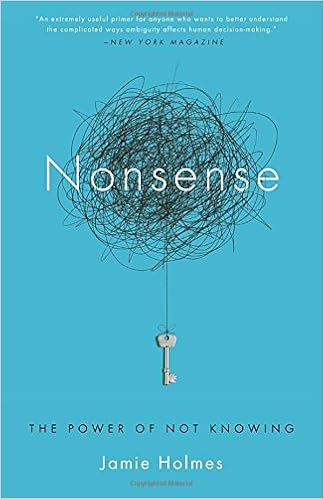
Homes, Jamie (2016): Nonsense - The Power of Not Knowing

What is it about?

The book is about ambiguity (i.e. situations which appear ambiguous to "us"), and how we deal with and should deal with it.

Instead of a scholarly account, or something approaching or based on it, the book is laden with short stories or case illustrations, which are supposed to elaborate on the propositions advanced by the author.

I'm not sure if there is a clear-cut basic message in the book, but it could be something along the lines of ambiguity increasing all the time in the modern world, and consequently people must be capable of effectively dealing with it - something that the school system should prepare our young.

Was it good?

To be honest, I expect a bit more from the book. The topic is quite interesting, but the book in a way did not fully deliver. The book is more of a collection of quite interesting stories or case illustrations, but a strong red thread throughout the book was a bit lost on me.

Thus, the book does not compare in terms of quality to Malcom Gladwell's comparable works, for example.

The main take-away for me?

This is quite hard to tell. Well, some of the stories, especially in the beginning of the book provide quite useful hints concerning how to eliminate and intentionally bring about ambiguity in social situations to one's benefit. Thus, ambiguity can be used tactically in social interactions.

Who should read the book?

This is so very general interest book, that it should be readily accessible to everyone. On the other hand, the lack of a clear-cut red thread throughout the book makes it quite hard to really recommend the book to anyone. Thus, instead of this one, I would recommend any of Malcom Gladwell's books instead - they cover quite similar issues, if not ambiguity as such in a book-long treatment,

The book on Amazon.com: Nonsense - The Power of Not Knowing